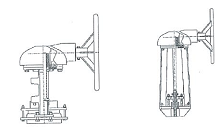
Wear due to hard particles or hard protuberances forced against and moving along a solid surface.
A test method designed to force products to fail more quickly than they would under normal use conditions. Accelerated life testing involves acceleration of failures with the single purpose of quantification of the life characteristics of a product at normal use conditions.
Chemical which speeds the vulcanization of an elastomer, so that it takes place in a shorter time or at a lower temperature. Picking up where an activator leaves off, an accelerator is often used in conjunction with a catalyst, hardener or curing agent.
Screw thread profile used in translational applications such as those involving large loads transmission. It was developed as a compromise to offer better strength than a 60 degree V-form thread while overcoming the problems with manufacturability of the square thread form. It uses a 29 degree thread angle with flat apex and valley.
An extension which is added to a short end-to-end valve to conform to either standard or customized end-to-end dimensions. Also termed Spool Piece.
A substance added in small amounts to an elastomeric compound to improve, strengthen or alter its properties. For example, a reinforcing agent to improve strength or a plasticizer to aid flexibility and processability.
See Explosive Decompression.
A trade association which represents local energy utility companies that deliver natural gas throughout the United States. www.aga.org
Change in rubber characteristics over time brought about by environmental factors such as heat and light. Accelerated aging of plastic materials is covered by ISO 188 and by ASTM D573.
An association of steel producers which sets standards for the chemical and physical properties of steel and iron in various shapes and forms - pipe, tubing, sheet, strip and wire. www.steel.org
The prevailing temperature of the environment immediately surrounding a system.
An organic compound that contains nitrogen as the key atom. Amines are basic compounds with strong odor. They are used as curing agent for fluoroelastomers; also a film-forming inhibitor used to prevent corrosion in oil-field tubular goods.
A pin fitted onto the body of quarter turn valves. This pin aligns the adapter plate and restrains the plate and gear operator from moving while the valve is being operated. Also termed Dowel Pin.
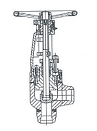
A variation of the globe valve, in which the end connections are at right angles to each other rather than being in line.
The principal standards writing organization in the United States which oversees the creation, promulgation and use of norms and guidelines that directly impact businesses in nearly every sector. www.ansi.org
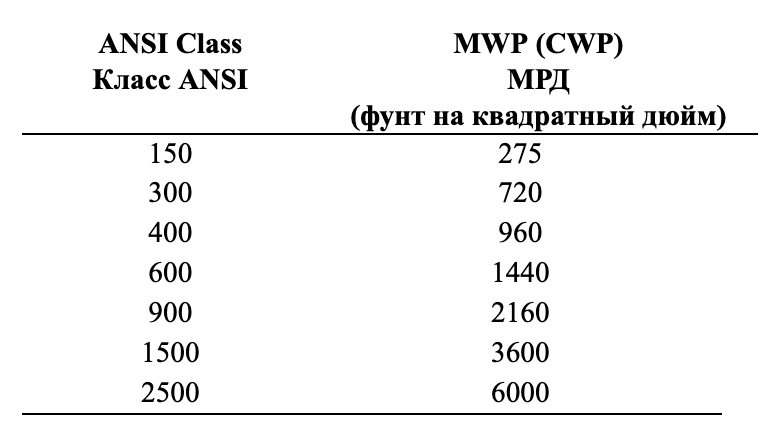
Numerical pressure design class defined in ASME B16.5 and used for reference purposes. The ANSI rating class is designated by the word 'Class' followed by a number.
Relatively hard, high modulus ring (or similar device) placed in the gland between the seal and the groove side walls to prevent extrusion of the seal into the clearance gap. Also termed Back-up Ring.
The main United States oil and natural gas industry trade association. Among the other programs, it has some standards and recommendation practices writing development functions for the petroleum and petrochemical industry. www.api.org
An API / ISO specification dealing with pipeline valves. Most pipeline valves are manufactured to this specification and can be identified with the API 6D monogram. Over the years, many standards have been incorporated into the state and federal regulations; more recently mutual adoption of a number of standards occurred with the International Organization for Standardization (ISO).
A fire test for valves in accordance to the American Petroleum Institute's (API) test specification.
A not-for-profit professional organization focused on technical, educational and research issues of the engineering and technology community. It publishes many technical books, papers, codes and standards. Of principal interest is the ASME Boiler and Pressure Vessel Code, which is referred for many aspects of valve design and fabrication, although not for the valves themselves. www.asme.org
A voluntary standards development organization originally known as American Society for Testing and Materials. It is a not-for- profit organization that provides a forum for the development and publication of consensus standards for materials, products, systems and services. Valves of most manufacturers are made of materials which comply with ASTM standards. www.astm.org
The force per unit area exerted against a surface by the weight of the air above that surface. At seal level the weight of the air corresponds to 14.7 psia, i.e. 1.013 bara.
A non-profit organization which sets guidelines and standards for welding and related joining technologies www.aws.org
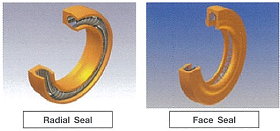
A seal that seals on a plane perpendicular to its axis instead of on its outside diameter (OD) or inside diameter (ID). Also termed Face Seal.
B
A shoulder on a gate valve stem which seals against mating surfaces inside the bonnet to allow for the replacement of stem packing or stem seal, under pressure.
The spherical closure element (obturator) of a ball valve.
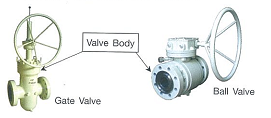
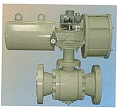
A valve which has a ball shaped component inside the body of the valve. The ball valve is rotated through to 90° (quarter turn) to open or close the valve. It is used to isolate or control the flow of oil or gas.
A metric unit of pressure. It is not a SI unit, but it is accepted for use with the SI. 1 bar = 14.504 psi = 0.1 MPa.
An abbreviation for "barrel". It is the name of several units of volume. One barrel of oil equals 42 US gallons, i.e. 158.99 liters or 34.97 UK gallons.
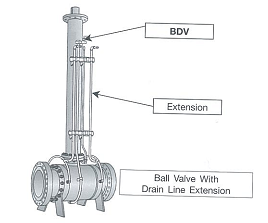
A small ball valve that is installed on the aboveground end of an extended drain line. This valve also serves to vent body cavity pressure in the "block and bleed" mode. See also Block and Bleed and Extended BDV.
A conical shaped disc spring called after its inventor Julian Belleville who patented the product in 1867. It is used in some valves to push the seats against the closure element. Also termed Belleville Washer.
The mechanical load produced by a force applied to a part at right angles to its surface or axis. Its magnitude is the product of the force times the perpendicular distance to the point of restraint. Usually expressed in N-m (SI unit) or pound-feet.
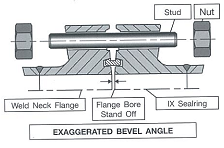
An edge of a structure that is not perpendicular to the two adjacent surfaces. It is used to term weld end preparation. See End Bevel.
The actuation of a valve by means of a set a gear where the axes of the two shafts intersect and the tooth-bearing faces of the gears are conically shaped. The reduction ratio of this gear determines the torque ratio achieved. Mostly used on gate valves.
Valve designed for blocking the fluid and can be installed with either of the flange ends in the upstream or downstream direction.
Connected to the valve body cavity used to release or bleed the fluid or gas.
Flange with no center bore, used to close off completely a flanged end or outlet connection.
Raised area on the surface of a molded product caused by the pressure of internal gases. See Explosive Decompression.
The capability of obtaining a seal across the upstream seat of a valve when the body pressure is bled off to atmosphere through blow down valve or vent port. See Double Block and Bleed Valve.
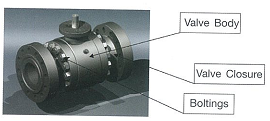
The principal pressure containing part of a valve, in which the closure element and the seats are located.
A fastener comprised of a screw and a nut.
The circle on which bolt holes are located.
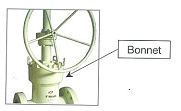
The top part of a valve joined to the body which guides the stem and adapts to extensions or operators.
Describes a valve construction in which the pressure shell elements are bolted together and thus can be taken apart and repaired in the field.
Bolts or studs and nuts are sometimes supplied with flanged valves to install the valve between line flanges.
The inside diameter of the smallest opening through a valve. The diameter of the hole in the ball of a ball valve; the diameter of the hole in the gate of a gate valve; the inside diameter of seat rings.
Thrust or torque required for moving a valve from the fully closed position and under a pressure differential.
Brinell hardness is determined by forcing a hard steel or carbide sphere of a specified diameter under a specified load into the surface of a material and measuring the diameter of the indentation left after the test. The Brinell hardness number or simply the Brinell number is obtained by dividing the load used in kilograms by the actual surface area of the indentation in square millimeters. The result is a pressure measurement, but the units are rarely stated. ASTM E10 is a standard test for determining the Brinell hardness of metallic materials. Can be converted to Rockwell В or С hardness by reference to conversion tables in ASTM E140. See Rockwell Hardness Test.
Tendency to crack or snap when subjected to stress or deformation.
Lowest temperature at which rubber materials do not exhibit brittle failure when impacted under specified conditions.
A relief valve installed on double-seated valves used in liquid service to provide for the relief of excess body pressure caused by thermal expansion.
It refers to British Standard.
Describes the sealing capability of a valve. During gas pressure testing of a valve in the closed position, leakage past the seat is collected and bubbled through water. To qualify as "bubble tight", no bubbles should be observed in a prescribed time span.
The ratio of the hydrostatic pressure to the volume strain. It actually determines how much a material compresses under a given amount of external pressure. Expressed in stress units, e.g. GPa, ksi, etc. A representative value of the bulk modulus for steel is 160 GPa and for water is 2.2 GPa.
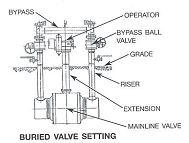
An application in which a valve is installed in lines which are buried below ground level.
That pressure at which rupture of a stressed element or pressure- containing vessel takes place. See Tensile Strength.
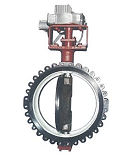
A short face-to-face valve which has a movable obturator in the center of the flow stream and rotates 90° as the valve opens and closes.
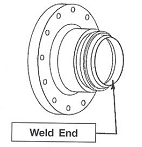
The end connection of a valve suitably prepared for buttwelding to a connecting piping. Governed by ASME B16.25. See WE and End Bevel.
A system of pipes and valves permitting the diversion of flow or pressure around the main valve.
C
A hollow cylindrical trim element that is a guide to align the movement of a valve plug with a seat ring and also retains the seat ring in the valve body. Often the walls of the cage contain opening which determines the flow characteristics of the control valve.
Rate of flow through a valve under stated conditions.
A fastener having a head and whose shank is normally threaded throughout its entire length. Not used with a nut, but rather engagement is made with a female thread in the piece to be joined.
A part made by pouring molten metal into a mold without any further forging or rolling.
The formation and subsequent collapse within a liquid of cavities or bubbles that contain vapor or gas or both. Cavitation originates from a local decrease in hydrostatic pressure in the liquid, produced by motion of the liquid or of a solid boundary. The term cavitation should not be used to denote the damage or erosion of a solid surface that can be caused by it. This effect of cavitation is termed cavitation damage or cavitation erosion.
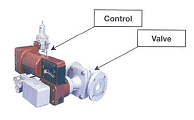
An automatic throttling valve controlling flow or pressure in a pipeline; comprising a package involving a ball valve, an actuator, a positioner and controlling instruments.
The CE marking is a mandatory European marking for certain product groups placed on the European Economic Area (EEA) to indicate conformity with the essential health and safety requirements set out in European Directives. To permit the use of a CE mark on a product, proof that the item meets the relevant requirements must be documented.
An independent body appointed by the purchaser to carry out a survey of the equipment and/or materials that they are buying. It is the responsibility of the supplier to provide the C.A. with information, documents, access to works and personnel to enable the survey to be carried out.
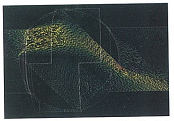
It is a branch of fluid mechanics that uses numerical methods and algorithms to analyze and solve problems involving fluid flows. The basis of almost all CFD problems are the NAVIER STOKES equations. Finite element method is the most used. The domain is divided into several little volumes in which the conservation equations are discretized and solved.
An overhead valve operated by a chain drive wheel instead of a handwheel.
A ball or gate, the shape of whose port has been altered to provide a specific throttling capability. One of the most common is the V-Port ball design.
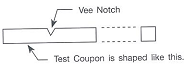
A mechanical dynamic test that provides a measure of the energy required to break a material under impact loading. The test consists essentially of a hammer with a given amount of energy striking a notched specimen of fixed dimensions. The measured test values may be the energy absorbed, the percentage shear fracture, the lateral expansion opposite the notch or a combination thereof. It provides a relative measure of the toughness of steel or its resistance to shock or impact loads. Often required for low temperature applications where testing is done at the expected minimum service temperature. Test procedure is defined in ASTM A370.
A unidirectional valve which is opened by the fluid flow in one direction and which closes automatically when the flow stops or reverses direction.
The hinged closure element of a swing check valve.
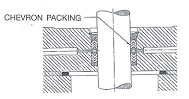
A type of packing used in packing boxes consisting of a nest of "V" cross-section rings. Also termed Vee-pack.
A choke valve is a valve that lifts up and down a solid cylinder (called a "plug" or "stem") which is placed around or inside another cylinder which has holes or slots. The design of a choke valve means fluids flowing through the cage are coming from all sides and that the streams of flow (through the holes or slots) collide with each other at the center of the cage cylinder, thereby dissipating the energy of the fluid through "flow impingement". The main advantage of choke valves is that they can be designed to be totally linear in their flow rate.
It is a limiting, or maximum, flow condition which either incompressible or compressible fluids can reach in passing through a control valve. It is evidenced by the failure of increasing pressure drop to produce further flow increases. With gas or vapor it occurs when flow velocity reaches sonic value in the vena contracta. With liquid, choked flow indicates fully developed cavitation. The pressure drop over which flow becomes choked is called terminal $\Delta p$.
A method of coating metals with another metal and where the coating becomes an integral part of the base material. This is usually done by welding. Also termed Weld Overlay.
Developed as the high pressure, low weight, leak-free alternative to the ANSI flange. The clamp connector does not rely on complex bolting to maintain seal integrity, but offers the strength of a welded joint. This design is the preferred solution where space, weight and joint integrity are critical. Typically of a proprietary design, e.g. Destec, Grayloc (Oceaneering International) and Techlok (Vector International).
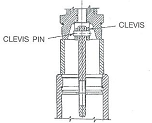
A "U" shaped connecting yoke at the end of a stem, between the ends of which a gate or other part may be pinned or bolted. It allows rotation of the connected parts about the axis of the pin.
The ends of a ball valve bolted to the body which usually contain the seat rings. Often referred to as part of the body.
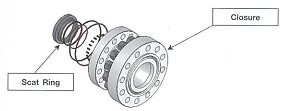
The moving part of a valve, positioned in the flow stream which controls flow through the valve. Ball, gate, plug, clapper, disc, etc. are specific names for closure elements. Also termed Obturator.
Increasing deformation of a material under a constant load at temperatures within the working range. Also termed Creep.
Compact flange was developed by Steel Products Offshore A/S, using extensive testing and finite element analysis. This design is a smaller and lighter alternative to conventional ANSI flanges. Has been adopted in Norsok Standard L-005 "Compact flanged connections".
A thermodynamic property used to modify the ideal gas law in order to take into account the real gas behavior. Usually, deviation from ideal behavior becomes more significant when the gas is closer to a phase change, with very low temperature or with very high pressure.
The ratio of the compression stress to the resulting compression strain below the proportional limit (expressed as a percentage of the original specimen thickness). Defined in ISO 604 and ASTM D695.
Thermoset molding technique in which the uncured rubber compound is put in a heated, open mold cavity and the mold is closed under pressure (often in a hydraulic press). The material flows to completely fill the cavity. Pressure is maintained until curing is complete.
The permanent deformation remaining after release of a compressive stress on an elastomeric specimen. Compression set is expressed as the percentage of the original deflection. Referred to in ISO 815 and ASTM D395.
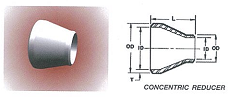
Having the same centers.
A particle or material which is foreign to the fluid media.
A valve that controls a process variable, such as pressure, flow or temperature by modulating its opening in response to a signal from a controller. See Controller.
A device that measures a controlled variable, compares it with a predetermined setting and signals the actuator to re-adjust the opening of the valve in order to re-establish the original control setting.
The change in the properties of a metal by chemical or electrochemical reaction with its environment.
Nonferrous-based alloy in which any one of the sum of the specific amount of the elements titanium, nickel, cobalt, chromium, and molybdenum exceeds 50% in weight.
A type of gate valve using runners or slides as a guiding mechanism operating in high-temperature applications, for example +300°C.
A chemical process whereby complex organic molecules such as heavy hydrocarbons are broken down into simpler molecules by the breaking of carbon-carbon bonds.
Increasing deformation of a material under a constant load below the yield strength. Also termed Cold Flow.
A form of accelerated localized corrosion occurring at locations where easy access to the bulk environment is prevented, such as mating surfaces of metal assemblies.
See Chocked flow.
Any temperature below approximately -196°C.
A valve capable of functioning at cryogenic temperatures below -196°C, commonly used in LNG plants.
The volumetric flow rate of water, in US gallons per minute at 15.6°C (60°F), passing through a valve and resulting in a pressure drop of 1 psi. See also Flow Coefficient Kv.
See MWP.
A single complete operation or process returning to the starting point. A valve stroked from full open to full closed and back to full open has undergone one cycle.
A procedure whereby a product is put through an interval of time during which a phenomena is completed. This can be a set number of events or it can be a continuous operation until something in the product fails.
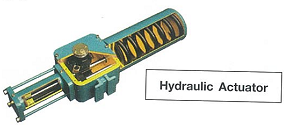
A power-piston valve operator which uses either hydraulic or pneumatic pressure. A sealed piston converts applied pressure into a linear piston rod (stem) motion. See Power Operator.
D
Process of removing excess material (flash) from the parting line of a molded rubber product.
See Differential Pressure and Pressure Drop.
A procedure by which a certifying authority appointed by the purchaser, appraises the design parameters of the equipment and/or materials he is buying. The supplier shall submit drawings, calculations and documents as required to the certifying authority in conjunction with those normally required for review and acceptance by the purchaser. See also Certifying Authority (CA).
The piping system in which the valve is operating in has a design temperature. The valve must be designed to this temperature.
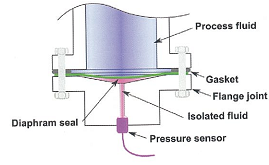
A round, thin, flexible sealing device secured and sealed around its outer edge and sometimes around a central hole in the diaphragm with its unsupported area free to move by flexing.
Consists of a valve body with two or more ports, a diaphragm and a seat upon which the diaphragm closes the valve.
The difference in pressure across a valve in a pressurized line. The difference in pressure between any two points in a pressurized system under flowing conditions.
Extending the blow-down valve on large gate valves requires a tube which is located inside of the valve. This tube is called the Dip Tube and extends through the bonnet to the bottom of the body cavity.
The closure element of a globe angle or small regulator valve. The disc also termed plug, moves to and from the seat in a direction perpendicular to the seat face. Depends on stem force for tight shutoff.
A valve with two seating surfaces that in the closed position provides a seal against pressure from both ends of the valve with a mean of venting/bleeding the cavity between the seating surfaces.
A single valve with two seating surfaces, each of which in the closed position provides a seal against pressure from a single source, with a means of venting/bleeding the cavity between the seating surfaces. This feature can be provided in one direction or in both directions.
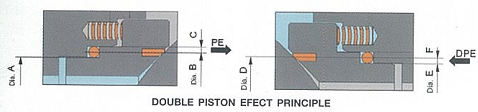
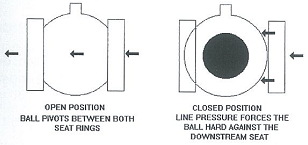
The sealing principle of ball valves whereby line pressure is used on both the upstream and downstream floating seats to effect a dead-tight seal simultaneously on both sides of the ball. With the DPE seat configuration when the upstream seat leaks, the pressure entering into the body cavity acts on the downstream seat, which being of the PPE design is then pushed against the ball and the valve seals in both directions.
See Anchor Pin and Drive Pins.
A fitting at the bottom of a valve, the removal of which permits draining and flushing the body cavity. The vent plug assembly on some ball and gate valves also serves as a drain valve. See Vent Plug.
The pins which fit into the bottom of a ball valve stem and engage corresponding holes in the ball. As the operator turns the stem, the drive pins turn the ball. The drive pins transmit the drive torque by shear. The drive pins can be replaced by a tang-drive connection integrally machined in the valve stem.
All parts of a valve drive between the operator and the obturator, including the obturator, but excluding the operator. It shall include also the Anchor Pin.
A drop in set (outlet) pressure of a regulator or control valve due to the travel of it's valve or poppet, as the required flow increases from low to maximum. A slight change in the control spring length due to the valve travel will result in spring force variations, translating into a change of set (outlet) pressure.
A sliding bearing consisting of a PTFE (Teflon) and lead powder lining bonded to a metal backing. Also termed DU® bearing, which is a trademark of GGB. www.ggbearings.com
Dry-film molydisulphide applied as a coating to sliding or rotating parts to reduce frictional drag. After application, the film is baked in an oven at high temperature.
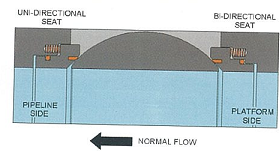
A combination of one unidirectional seat and one bi-directional seat installed in the same valve body. The directions of both seats shall be specified on a separate identification plate. This design provides two sealing barriers in one direction and one sealing barrier in the opposite direction.
Valve with two seats, each sealing in both directions.
Valve with two seats, one sealing in one direction and the other in either direction.
The Durometer (also called Shore Durometer) measures hardness in terms of material elasticity. A diamond-tipped hammer is used to strike the testing surface from a known height. The rebound of the hammer is measured. The harder the material, the higher the rebound. See Shore Hardness.
See Liquid Penetrant Test.
E
A natural or synthetic elastic material composed of long, chainlike molecules that are capable of recovering their original shape after being stretched to great extents. Under normal conditions the long molecules making up an elastomeric material are irregularly coiled. With the application of force, the molecules reconfigure themselves to distribute the applied stress returning to its original configuration when the stress is removed. Used in synthetic rubber parts such as O-rings.
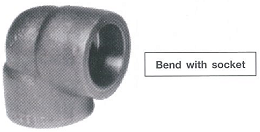
A female threaded or socket fitting used for changing direction in a run of pipe or tubing.
An auto-catalytic reaction used to deposit a coating of nickel- phosphorous alloy on a substrate without passing an electric current through the solution to form the deposit. This plating technique is mostly used to prevent corrosion and wear on metallic materials. Refer to ASTM В 656 (a standard guide which provides information about ENP) and ASTM В 733 (a specification which defines requirements for ENP).
Percentage increase in original length (strain) of a specimen produced by a tensile force (stress) applied to the specimen. Ultimate elongation is the elongation at the moment the specimen breaks.
Loss of ductility of a material due to chemical or physical change. See also SSC (Sulphide Stress Cracking).
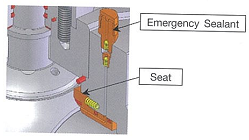
To obtain tight shut off in an emergency situation, a sealant can be injected into a specially designed groove in the seat rings and/or in the stem seal pockets. Available for most ball valves and gate valves.
Weld end preparations for butt-welding. Governed by ASME B16.25.
The type of connection supplied at the ends of a valve which allows its installation on a pipeline. Weld end (WE), raised- face flange (RF), ring-type joint (RTJ) are the most common end types.
It refers to European Standard.
The abbreviation stands for Ethylene Propylene Diene Monomer. It is a popular seal material that is compatible with fireproof hydraulic fluids, ketones, hot and cold water and alkalis. But, it is not compatible with most oils, gasoline, kerosene, aromatic, aliphatic hydrocarbons, halogenated solvents and concentrated acids.
An inherent flow characteristic which for equal increments of rated travel will ideally give equal percentage changes of the existing flow.
Progressive loss of original material from a solid surface due to mechanical interaction between that surface and a fluid, a multicomponent fluid or impinging liquid or solid particles. Because of the broad scope of this term, it is recommended that it normally be qualified to indicate the relevant mechanism or context, for example cavitation erosion, liquid impingement erosion, solid impingement erosion, beach erosion, etc.
The Pipeline Safety Regulation [A guide to the Pipelines Safety Regulations 1996 - Guidance On Regulations: ISBN 0-7176-1182-5 82] states that an "emergency shut-down valve" is a valve which is capable of adequately blocking the flow of fluid within the pipeline at the point at which it is incorporateG. In the absence of a definition, "adequate" is taken to mean sufficient for a particular purpose. Minor internal leakage past the ESDV may be accepted providing it does not represent a threat to safety. The rate of leakage should be based on the installation's ability to control safely the hazards produced by such a leak.
A highly productive welding process for thick materials. It involves the melting of the surfaces of the metal workpieces and the filler metal with a molten slag to cause coalescence. An electric arc is passed through the slag to heat it, but the arc itself is extinguished by the slag.
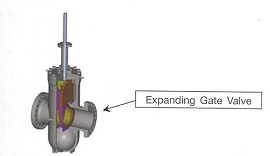
A gate valve that is comprised of a separate gate and segment that, as the valve operates, the gate and segment move without touching the seats, permitting the valve to be opened and closed without wear. In the closed position the gate and segment are forced against the seat. Continued downward movement of the gate causes the gate and segment to expand against the seats (see Mechanical Seal). When the valve reaches its full open position the gate and segment seal off against the seats while the flow is isolated from the valve body.
The prevention of explosion triggered by electrical components through containment in special housings. A requirement for electrical devices such as solenoids and switches when exposed to a potentially explosive environment.
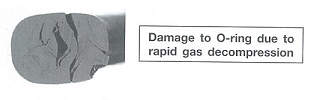
Phenomenon occurring in rubber seals after exposure to high- pressure gas. This gas permeates into the elastomer through flaw sites present in all molded rubber products. During an equilibrium shift (rapidly lowered pressure), the gas expands within the seal causing internal ruptures in high shear modulus (hard) materials and surface blisters in low shear modulus (soft) materials.
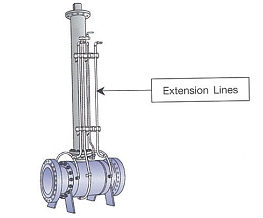
Used on buried valves where the drain plug is inaccessible. Instead, a line is piped above ground, terminating in a small valve. Line pressure is used to blow-out condensates and other material which settles in the bottom of the body cavity. See BDV.
A bonnet with an extension between the stem seals and bonnet flange for hot or cold service.
The equipment applied to buried valves to provide above ground accessibility to operating gear, blow down and seat lubrication systems.
Coating applied to protect valves against various environments i.e. sea air, salt water, earth buried and normal air exposure.
Pressure-induced distortion or extension of part of a seal into the clearance gap between mating seal surfaces.
F
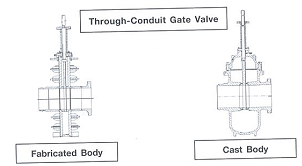
A valve in which the body is neither cast nor forged but rather is formed from plate or pipe welded together.
The overall dimension from the inlet face to the outlet face of the valve (one end to the other). This dimension is governed by ASME B16.10 and for pipeline valves, API 6D / ISO 14313, to ensure that such valves are mutually interchangeable regardless of the manufacturer.
The finishing of the contact surface of flanged fittings.
When there is a failure in the pipeline system, the actuated valve is designed to automatically either open or close the valve.
The phenomenon leading to fracture under repeated or fluctuating stresses having a maximum value less than the tensile strength of the material.
Fatigue resistance verification of a component subjected to a number of design/operating cycles.
See RF and RTJ.
A numerical method of analyzing complex shapes by organizing the volume into a series of smaller elements which can be more accurately analyzed to determine whether or not components are suitable for their intended purpose.
An internal screw thread designed to mate with a component having male (external) threads of the same size and type.
An equipment is field serviceable when normal repair or replacement of operating parts can be accomplished in the field without returning to the manufacturer.
The temperature at which a fuel will continue to burn after ignition.
This is a term used to describe the fire resistance ability of a valve when exposed to fire. In order to qualify for this certification, a valve is required to be exposed to fire for a 30-minute period. Once acceptable leakage (through the test valve and also external leakage) has been confirmed, the valve is considered to be firesafe. Some common fire testing specifications include ISO 10497, BS 6755 Part 2, API Spec 6FA, API Spec 6FC, API Spec 6FD and API 607 (3rd Edition).
Any device used for connecting elements in fluid lines e.g. elbows, tees, nipples, unions, flanges, etc.
A cast or formed pipe fitting consisting of a projecting radial collar with bolt holes to provide means of attachment to piping components having a similar fitting. The end piece of flanged-end valves.
Excess of materials attached to a molded product which usually must be removed.
The lowest temperature at which a flammable liquid can form an ignitable mixture in air.
The phenomenon by which a fluid vaporizes due to sudden pressure drop across a valve. Particularly, it occurs when the downstream pressure is below the upstream vapor pressure value. Beside physical damages, the occurrence of flashing within a control valve results in a decreased ability of the valve to convert pressure drop across it into mass flow rate.
A special valve using a flexible sleeve or tube which acts as the closure element. Pressure applied to the jacket space surrounding the outside of the tube controls the opening and closing of the valve.
A ball valve having a non-trunnion-mounted ball. The ball is free to float between the seat rings and thus causes higher torques.
A fluid in motion in a conducting line.
The volumetric flow rate of water, in cubic meters per hour, at a temperature between 5°C and 40°C, passing through a valve and resulting in a pressure loss of 1 bar. When expressed in Imperial units it is known as Cv.
An instrument used to measure flow rate or total flow or both.
The volume or weight of a fluid passing through a pipeline or conductor per unit of time.
Any non-solid substance that can be made to flow. Both liquids and gases are fluids.
Carbon backbone, organic compound having fluorine atoms in its chemical structure. Presence of the fluorine provides increased chemical and high temperature resistance.
The intensity of an influence tending to produce motion, distortion or change of shape. The product of pressure (bar) and the area over which it acts. Usually expressed in Newton (SI units) or pounds (non-SI units).
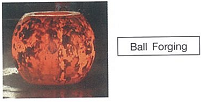
A part that is formed by heating and hammering to a specific shape.
Small amplitude oscillatory notion usually tangential between two solid surfaces in contact.
A form of fretting wear in which corrosion plays a significant role.
Wear arising as a result of fretting.
The resistance to motion between two contacting surfaces or substances. Friction is also developed between a flowing fluid and the inner wall of the conducting pipe-resulting in a drop in pressure.
A fugitive emission is defined as a leak from a fluid (e.g. hydrocarbons, chemical or mixture of chemicals). The fugitive emission (FE) test is carried out to evaluate the ability to suppress and/or the performance level of on/off valves and control valves with regards to FE. The specification for FE testing describes the type of detection method and test medium to be used and specify the acceptance and rejection criteria.
See Full Opening.
Describes a valve whose bore (port) is nominally equal to the bore of the connecting pipe. See Venturi Valve.
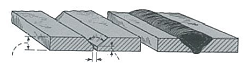
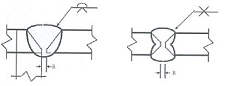
Describes the type of weld wherein the weld metal extends across the entire wall thickness of the joint.
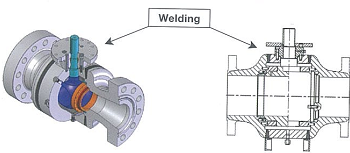
Refers to a ball valve whereby the body and closure joints are fully welded to complete the valve assembly. This type of valve construction cannot be disassembled nor repaired at site.
A process by which weld materials, with superior properties than the substrate are applied to the substrate. Often two layers total 3-6 mm thick are applied to reduce the surface hardness dilution of the relatively low-cost steel substrates in the expansive cobalt- based alloys. Hardfacing processes are very useful for improving wear and corrosion resistance to selected areas of mechanical equipment such as cutting edges of earth-moving machinery or sealing areas of valves. Common hardfacing techniques include arc torch (GMAW, GTAW, SMAW, SAW) and other processes (ESW).
G
A form of surface damage arising between sliding solids, distinguished by macroscopic usually localized roughening and creation of protrusions above the original surface it often includes plastic flow or material transfer or both. The onset of galling usually requires that the contact pressure exceeds some threshold value. Galling can be a precursor to seizing or loss of function.
Corrosion associated with the current resulting from the electrical coupling of dissimilar materials (electrodes) in an electrolyte.
A compressible fluid such as air, hydrogen, nitrogen etc.
A seal or packing placed between mechanical joints (such as flanges) to prevent the escape of the flowing medium.
Gas testing can be divided into 2 categories, namely high- pressure and low-pressure gas testing. Both these tests are considered supplementary test requirements within the API 6D specification. For the low pressure gas test, nitrogen is most often used along with acceptance criteria based on ISO 5208. For the high pressure gas test, the standard hydrostatics seat test required by API 6D is carried out using an inert gas (usually helium) as the test medium.
The closure element of a gate valve.
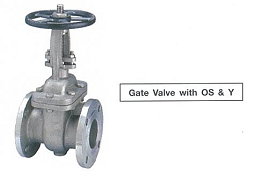
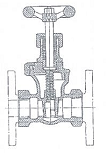
A straight-thru pattern valve whose closure element is a wedge or parallel-sided slab situated between two fixed seating surfaces with means to move it in or out of the flow stream in a direction perpendicular to the pipeline axis.
An instrument usually with a threaded connection for measuring and indicating the pressure in a piping system at the point at which it is connected.
That part of a valve which retains or compresses the stem packing in a stuffing box (where used) or retains a stem O-Ring, lip seal or stem O-Ring bushing. Sometimes manually adjustable. See Packing and Stuffing Box.
The plate in a valve which retains the gland bushing or stem seals and sometimes guides the stem.
Temperature at which a viscous polymer loses its ability to flow or store energy, becoming hard and brittle (like glass).
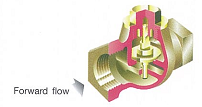
A valve whose closure element is a flat disc or conical plug sealing on a seat which is usually parallel to the flow axis. The tortuous flow path produces a relatively high pressure loss.
In GMAW, also known as metal inert gas (MIG) welding an electric arc is established between the workpiece and a consumable wire electrode. The arc continuously melts the wire as it is fed to the weld puddle. The weld metal is shielded from the atmosphere by a flow of an inert gas or gas mixture.
The actuation of a valve through a gear set which multiplies the torque applied to the valve stem. See BGO and MGO.
Also known as tungsten inert gas (TIG) welding it is an arc welding process that uses a non consumable tungsten electrode to produce the weld. The weld area is protected from atmospheric contamination by a shielding gas (usually an inert gas such as argon) and a filler metal is normally used though some welds, known as autogenous welds do not require it. A constant-current welding power supply produces energy which is conducted across the arc through a column of highly ionized gas and metal vapors known as a plasma.
H
Wheel consisting of a rim connected to a hub i.e by spokes and used to operate manually a valve requiring multiple turns.
A surface preparation such as Fusion Hardfacing detonation gun or High Velocity Oxy-Fuel (HVOF) in which a hard alloy is deposited on a metal surface to increase wear and/or corrosion resistance.
In metallurgy, hardness is defined as the ability of a material to resist deformation usually by indentation. Hardness measurement can be defined as macro, micro or nano-scale according to the forces applied and the displacements obtained.
A means of determining resistance to penetration. In the metal industry the most used tests are the Brinell hardness test, the Rockwell hardness test and the Vickers hardness test. These tests determine the resistance to the penetration of a non-deformable ball or cone by measuring the depth which such ball or cone sink into the metal under a given load within a specified period of time. ASTM A370 specifies procedures for Brinell Test and Rockwell Test.
Portion of the base metal which has not been melted, but whose mechanical properties or microstructure has been altered by the heat of welding or cutting.
A chemical analysis conducted by the foundry immediately prior to pouring which measures the exact chemical composition of a particular batch of molten metal. Does not include analysis of physical properties. See Mill Tests and Mill Certificate.
Describes any process or procedure by which the internal structure of steel is altered by heating to produce desired physical characteristics. This is usually accomplished by furnace heating followed by controlled cooling.
Furnace charts providing a temperature against time record of the heating and cooling cycle required by a specific heat treatment process for a particular furnace load of steel or steel parts.
The apparent area of contact between two non-conforming solid bodies pressed against each other as calculated from Hertz' equations of elastic deformation.
The magnitude of the pressure at any specified location in a Hertzian contact area as calculated from Hertz' equations of elastic deformation.
A planar cracking that occurs in carbon and low alloy steels when atomic hydrogen diffuses into the steel and then combines to form molecular hydrogen at trap sites. Cracking results from the pressurization of trap sites by hydrogen. No externally applied stress is needed for the formation of hydrogen-induced cracks. It is usually associated with low-strength plate steels used in the production of pipes and vessels.
An actuated valve and control system to protect against overpressure of pipeline risers.
An imperfection or bare spot in a coating or plating.
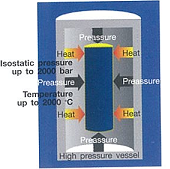
Special forming process used to compact and metallurgically bond metal powder. This process takes place within a flexible, metal container whose contents are formed into the desired shape by subjecting the container to high temperature and pressure in an autoclave. It produces a fully wrought structure.
The process by which a pipeline under pressure is cut into to provide a side outlet. A flanged fitting is saddle welded to the pipeline and a full port valve bolted to the flange. The hot tapping machine bolted to the outboard valve flange operates through the open valve. After cutting out a circular piece coupon from the pipe wall, the coupon is removed from the pipe by retracting it through the valve and into the chamber of the tapping machine. The valve is then closed and the tapping machine and coupon are then removed from the valve.
Cracking that results from the presence of hydrogen in a metal and tensile stress (residual and/or applied). HSC describes cracking in metals that are not sensitive to SSC (Sulphide Stress Cracking), but which may be embrittled by hydrogen when galvanically coupled to another metal that is corroding actively as an anode.
Protruding rim with an external angled shoulder and a sealing mechanism used to join pressure containing equipment.
A thermal spray technique used to deposit protective coating on a substrate. A blend of fuel (gaseous or liquid) and oxygen is injected into a torch and burned. The combustion products flow through a nozzle that accelerates the flow to a speed up to 1500 m/s. A powder feed stock is injected into the gas stream which accelerates the powder up to 800 m/s. The stream of hot gas and powder is directed towards the surface to be coated. The powder partially melts in the stream and deposits upon the substrate. The resulting coating has low porosity and high bond strength.
A valve on which the handwheel drives the stem directly to operate the valve.
Pertaining to or using water, oil or other liquids.
The movement of the seats in a valve is controlled by using water, oil or other liquids under pressure.
A test in which a valve is filled with water and pressure tested. According to ISO 14313 / API 6D, hydrostatic tests on a valve are: Hydrostatic Shell Test: done at a pressure 1.5 times the design pressure. See also Proof Pressure. Hydrostatic Seat Test: done at a pressure 1.1 times the design pressure.
It is a simulated pressure and depth test.
The difference between up-scale and down-scale results in instrument response when subjected to the same input approached from the opposite direction. It can be caused by a multitude of variables, packing friction, loose linkage, pressure drop, etc.
I
The measure of the inner diameter of a circular part.
A table summarizing data such as service, valve size, supply pressure, etc., necessary for actuator sizing.
The world's leading organization that prepares and publishes International Standards for all electrical, electronic and related technologies. All IEC International Standards are fully consensus-based and represent the needs of key stakeholders of every nation participating in IEC work. Every member country has one vote and a say in what goes into an IEC International Standard. IEC provides standards for control valve sizing.
It is the formation of cavities or bubbles in the liquid flow that begins when the pressure first dips below the vapor pressure. It is identified by a deviation from the quadratic relationship between volumetric flow rate and pressure drop and by an increased noise emission.
The leakage testing of valve seats in an assembled valve by increasing the applied pressure in prescribed pressure steps.
The property of a body or mass of resisting to a change in velocity.
It is the relationship between the flow coefficient and the corresponding valve travel. It is independent of the means of actuation. The most common types of inherent flow characteristics are linear, equal percentage, modified parabolic, and quick opening.
A fitting through which lubricant or sealant is injected.
The port which is connected directly to the upstream side of a fluid system.
Coating containing a zinc powder pigment in an inorganic vehicle.
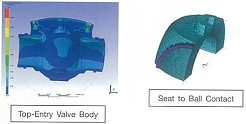
To maintain or repair a equipment "in its original place" such as a top-entry ball valve.
Intelligent pigs are inspection vehicles that move inside a pipeline pushed along by the flowing fluid. They are primarily used for the detection of wall thinning caused by ordinary corrosion.
A self relieving feature in non-independent seating valves that automatically relieves excessive internal body pressure caused by sudden changes in line pressures. By means of the piston effect principle, the excessive body pressure will move the seat away from its seating surface and relieve it to the lower pressure side.
It is a network of the national standards institutes of 157 countries. It is the world's largest developer and publisher of International Standards. ISO's work programme ranges from standards for activities such as agriculture, construction, engineering, manufacturing, logistics, information and communication technologies and services. www.iso.org
The ISO specification dealing with the fire testing of pipeline valves.
K
A method of restricting the travel of a ball valve from fully open to fully closed and vice versa. The stem key bears against the ends of an arc machined in or attached to the adaptor plate.
The relative micro-hardness of a material is determined by the Knoop indentation test. In this test, a pyramid-shaped diamond indenter (called a Knoop indenter) is pressed against a material making a rhomboidal impression with one diagonal seven times longer than the other. The hardness of the material is determined by the depth to which the Knoop indenter penetrates.
L
The flow of a viscous fluid in which the fluid moves in parallel layers with a fixed velocity gradient from the centerline to the containing walls of the conduit. Sometimes referred to as Streamline Flow.
See Chevron Packing.
Rate at which a fluid (liquid or gas) passes a seal or barrier.
Lugs provided on equipment for lifting and positioning. Also termed Lifting Eyes.
An electrical device providing a signal to a remote observation station indicating when the valve is in the fully open or fully closed position. Usually a component of a valve operator.
A pipe, tube or hose for conducting fluids.
An inherent flow characteristic which can be represented ideally by a straight line on a rectangular plot of flow versus per cent rated travel. Therefore equal increments of travel yield equal increments of flow at a constant pressure drop.
A circular seal ring of U shaped cross section encompassing a spring element which provides resiliency and ensures a seal at the inner and outer lips of the U.
An NDE method of detecting the presence of discontinuities that are open to the surface such as cracks, seams, laps, cold shuts, laminations, lack of fusion in welds, castings or forgings, through the use of a special colored dye liquid. Techniques and procedures are covered in ASME V, Art. 6 and ASTM E165.
A device that can be fitted to either lever or gear operated valves to allow for the valve to be locked in either the fully open or closed position.
Seats which are equipped with a lubricant injecting system. See Emergency Sealant Injection.
Any substance interposed between two surfaces for the purpose of reducing the friction or wear between them.
M
An inspection procedure for detecting surface cracks and other discontinuities at or near the surface in ferromagnetic materials through the use of fine iron particles in a magnetic field. Techniques and procedures are covered in ASME V, Art. 7 and ASTM E709.
The external thread on pipe, fittings or valves used in making a connection with mating female (internal) threaded parts.
A common pipe or chamber having several lateral outlets. Also termed Header.
An abbreviation for **Maximum Allowable Operating Pressure**. Determined in accordance with piping codes, DOT regulations, etc.
An instrument used for sorting streams of electrified particles in accordance with their different masses by means of deflecting fields. The instrument can produce a photographic or graphic record of each compound and the percentage of the compound. Most commonly used in analyzing petroleum and steel products.
The material data sheet defines the minimum requirements for the materials, i.e. chemical specifications, manufacturing, qualification of supplier, mechanical testing and properties, non destructive examination, repair, marking and certification.
In a valve a shut-off that is accomplished by a mechanical means rather than with fluid or line pressure. The wedging action of a gate against the seats or the seat springs pushing the seat against the ball or gate are examples of mechanical seals in a valve.
The coating of a non-metallic surface with a thin metal layer by spraying, hot dipping or vacuum deposition.
The sealing contact area is **metal to metal** between the sealing face of the seat ring and the closure element. For example, in a ball valve, the ball and seats contact and seal area is metal to metal. This is typically used in severe service applications.
A system used to check or "prove" a flow meter. A close fitting sphere is launched into a pipe of known inside diameter. The flow medium pushes the sphere through a measured length of pipe between two sphere detection devices. Knowing the transit time and the exact volume between the two stations, a flow rate is calculated and compared with the meter reading.
A section of pipeline in which a meter is installed to measure the volume of fluid passing through the line.
A gear operator that is operated manually with a handwheel.
Certificates provided by the steel mill indicating the **chemical analysis** and **physical properties** of a specific batch of steel. See **Heat Analysis**.
All tests required by the material specification usually include both the **heat analysis (chemical)** and the **physical properties**.
See **Mill Certificate**.
An abbreviation for **million cubic feet**. Used to designate gas volume and gas flow rates in pipelines (**MMCF per hour or day**).
See **Power Operator**.
The stress required to produce a certain elongation (strain) usually 100%. In elastomers it is a good indication of toughness and resistance to extrusion. Also termed **Tensile Modulus**.
See **Young's Modulus**.
A hollow cavity (frequently in packed sand) for giving a desired shape to a material in a molten or plastic state. Used in making metal castings.
The mass of one molecule of a substance expressed in **unified atomic mass unit**.
A field procedure whereby two valves (usually regulators) are installed in series and adjusted in such a manner that, should the primary regulator fail, the standby regulator will automatically take over at a slightly higher pressure setting.
A technical organization dedicated to the technical needs of the valve and fittings industry. Standards and codes are written and revised by technical committees and address topics such as valves, valve actuators, pipe fittings, flanges, and pipe hangers. Recommendations of this society are advisory only. www.mss-hq.com
A flow formed by a mixture of two or more distinct phases.
The maximum working pressure at which a valve can be operated.
N
A professional organization for the corrosion control industry established in 1943 which publishes papers articles and standards on all aspects of corrosion and has written the definitive standard for valve materials for sour gas service. Formerly known as the National Association of Corrosion Engineers. www.nace.org
A US standard for **tapered (NPT)** or **straight (NPS)** threads used to join pipes and fittings.
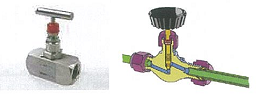
A type of small valve used for flow metering having a tapered needlepoint plug or closure element and a seat having a small orifice.
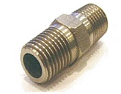
A short length of small size pipe threaded on both ends. Used on end connections of screwed-end valves and in small size piping systems.
The sound pressure level, usually expressed as **dB(A) (audible decibels)**, emitted by a control valve when operating under specified process conditions.
Those inspection tests which are not destructive to the product structure or function. See **RT (Radiographic Test)**, **Liquid Penetrant Test**, **Magnetic Particle Test**, and **Ultrasonic Test**.
A gate valve having its stem threaded into the gate. As the stem turns, the gate moves but the stem does not rise. Stem threads are exposed to line fluids.
An electrically operated valve whose inlet orifice is closed when the solenoid coil is not energized. **Energize to open**. See **Solenoid (Section 2)**.
An electrically operated valve whose inlet orifice is open when the solenoid coil is not energized. **Energize to close**. See **Solenoid (Section 2)**.
Numerical inches designation of size which is common to components in piping systems of any one size. The nominal pipe size is designated by the letters **NPS** followed by a number. See also **National Pipe Thread** and **API 6D / ISO 14313**.
O
The measurement of the outermost diameter of a circular part.
A device which converts manual, hydraulic, pneumatic or electrical energy into mechanical motion to open and close a valve.
A media temperature that the valve is operating in and will be required to be opened or closed at any time in this temperature range.
The time required for a power operator to stroke the valve from the full open to full closed position or vice versa.
An elastomeric or synthetic seal ring of circular cross section.
A valve in which the fluid does not come in contact with the stem threads. The stem sealing element is between the valve body and the stem threads.
The port which is connected directly to the downstream side of a fluid system.
P
The deformable sealing material inserted into a valve stem stuffing box which when compressed by a gland provides a tight seal about the stem. See Gland and Stuffing Box.
See Gland.
Required for cast components. It is a mold usually made from wood to form the mold into which molten metal is poured.
See Qualification Test.
Measure of the ease with which a liquid or gas can pass through a rubber material.
A thermo-setting resin applied to valve interiors and/or exteriors to inhibit corrosion.
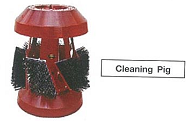
A device closely conforming to the pipe bore which is forced through a pipeline to clean the pipe of all foreign material and debris. Valves in a pipeline that will be pigged must be through- conduit full port otherwise the pig will not pass through them.
A spring loaded pressure regulator used to control the pressure and flow of other larger pressure regulators or instruments.
A regulator which is controlled by a second small volume high accuracy regulator or pilot. This arrangement has the advantages of improving performance by minimizing the effects of unbalance and droop. The number of possible applications are also increased since a wide range of pilot configurations are feasible.
The external input shaft of certain gear operators which drives internal reduction gearing. The pinion shaft can accept a handwheel or power operator.
On a buried valve, the gear operator pinion shaft must be extended above grade to permit the valve to be operated.
It is the corrective factor that accounts for pressure losses due to pipe fittings, such as reducers that might be attached directly to the inlet and outlet connections of the control valve.
The sealing principle involved in utilizing line pressure to effect a seal across the floating seats of some valves.
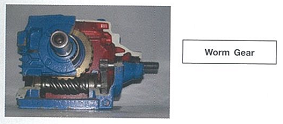
Pertaining to screw threads, the **pitch** refers to the measurement between adjacent threads. The **lead** refers to the distance the screw advances in one complete revolution. Worm gears of gear operators are also identified by pitch and lead. Speed of operation and torque required are related to pitch and lead.
A form of wear characterized by the presence of surface cavities, the formation of which is attributed to processes such as fatigue, local adhesion or cavitation.
The rotating closure element of a plug valve. Also a threaded fitting used to close off and seal an opening into a pressure containing chamber, e.g. pipe plug.
A quarter turn valve whose closure element is usually a tapered plug having a rectangular port.
Pertaining to using air or gas.
For most materials, a rod-like specimen subjected to uniaxial tension exhibits some shrinkage in the lateral direction. The ratio of lateral strain and axial strain is defined as Poisson's ratio. For most rubber materials, Poisson's ratio is equal to 0.5 (incompressible) and for metallic materials is about 0.3.
See Bore.
Any external device which visually indicates the open and closed position of a valve. See Stem Indicator.
Powered valve operators are of the following general types: Electric Motor, Pneumatic or Hydraulic Motor, Pneumatic or Hydraulic Cylinder. Operators can either be adapted directly to the valve stem or side mounted on existing gear or scotch-yoke operators.
Parts such as bodies, bonnets, glands, stems, gaskets and bolting designated to contain the pipeline fluid.
Parts such as seat and obturator intended to block or permit the flow of fluids.
See Differential Pressure.
The decrease in pressure along the direction of flow in a piping system caused by fluid friction restrictions and by change-of- direction fittings. Pressure drop is related to velocity-specific gravity viscosity and to the size and roughness of the pipe interior. See Differential Pressure.
The pressure drop ratio (total pressure drop over inlet pressure) required to produce choked gas flow through the valve without attached fittings.
The ratio between valve pressure drop and vena contracta pressure drop when flow becomes choked due to cavitation. It is determined with flow rate measurements, keeping upstream pressure constant and reducing downstream pressure until choked flow starts.
Regulator designed to control downstream pressure. See Regulator.
A safety device required on most pressure systems and is preset to relieve the line pressure should it exceed that limit.
A switch (usually electric) activated by a rise or drop in pressure. A Transducer.
A test using specified pressures of liquid or gases which can be used to check sealing, integrity, design standards etc. of a particular product.
First coat of paint applied to a surface, formulated to have good bonding and wetting characteristics may or may not contain inhibitive pigments.
Parts exposed directly to the fluid flowing in the line, i.e. ball or gate or seats.
A verification conducted by the valve manufacturer to assure that the chemical composition of received material coincides with the heat analysis and with the requirements of the applicable specification.
A hydrostatic test pressure usually **1.5 times** the rated working pressure applied to an assembled valve to verify the structural integrity of the pressure containing parts. Synonymous with **Hydrostatic Shell Test**.
A circular "pipe like" sleeve inserted in place of the ball and seats of a top-entry ball valve. This protective sleeve remains in place inside the valve during valve installation and ultimate pigging of a pipeline to clear debris from the line before placing the pipeline into service. Once the pipeline has been purged of all debris, the protective sleeve is removed entirely from the ball valve cavity and the operating trim (i.e. ball and seats) is then installed for normal service conditions.
Unit of measure of pressure. **Not a SI unit**.
The abbreviation stands for **Polytetrafluoroethyiene (Teflon)**. It is a type of fluorinated thermoplastic, with outstanding chemical resistance, low leachability and excellent lubricity. It has a maximum temperature limitation of 500 F.
Rythmical throbbing or vibrating in pipelines flow or pressure oscillation which is identically repeated in every fixed time interval. Pulsation is an inherent characteristic of reciprocating gas compressors and reciprocating liquid pumps. Pressure and flow pulsations interact with piping systems to cause vibration, metering errors and potential equipment damage.
A ball valve that is not meant for on-off service, but whose specific function is to control flow and prevent cavitation in pumps on liquid pipelines.
See Transition Piece.
Q
Additional testing requirements are performed on a product to determine whether or not the product conforms to all of the requirements of a particular specification. This is generally done by a **third independent party** to qualify a product for a specific application. Also termed **Performance Verification Test**.
R
Additional testing requirements are performed on a product to determine whether or not the product conforms to all of the requirements of a particular specification. This is generally done by a **third independent party** to qualify a product for a specific application. Also termed **Performance Verification Test**.
S
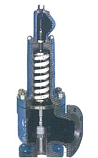
A quick-acting **spring-loaded valve** that opens (relieves) when the pressure exceeds the spring setting. It specifically opens **proportionally with pressure increasing**. Often installed on the body cavity of ball and gate valves to relieve **thermal overpressure** in liquid services.
Submerged Arc Welding is a common arc welding process. It requires a continuously fed consumable solid or tubular (flux cored) electrode. The molten weld and the arc zone are protected from atmospheric contamination by being submerged under a blanket of **granular fusible flux**. When molten, the flux becomes conductive and provides a current path between the electrode and the work.
Cracking of metals involving **anodic processes of localized corrosion** and **tensile stress** (residual and/or applied) in the presence of **wet hydrogen sulfide ($H_2S$)**.
A system for indicating the **wall thickness of pipe**. The higher the schedule number, the thicker the wall for a given pipe size.
A severe form of wear characterized by the formation of extensive grooves and scratches in the direction of sliding.
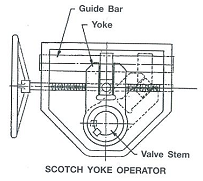
A quarter turn operator based on a **scotch yoke mechanism** rather than gears. The scotch yoke has a torque output at the beginning and ending of its stroke that is about **twice the magnitude of the torque output at the middle** of its stroke.
The mechanical removal or displacement (or both) of material from a surface by the action of abrasive particles or protuberances sliding across the surfaces.
Internally threaded end connections supplied on some (small size) valves. Usually **tapered pipe threads (NPT)**.
A device used to **prevent the passage of fluid**. Types include 'O' ring, lip seal, gasket, etc.
A sealing element used between parts that have **relative motion**, i.e. stem seals and seat seal.
A sealing element used as a gasket between **two non-moving parts**, i.e. valve bonnet seal and flange gasket.
That part of a valve against which the closure element effects a **tight shut-off**. In ball and gate valves, it is a floating member containing either a soft (plastic) or a metallic seating element.
Contact surfaces of the obturator and seat which ensure valve sealing.
The process whereby excessive internal body pressure is automatically relieved either into the upstream or downstream line by **forcing the seats off the closure element**.
Hardness measurement for rubbers/elastomers and softer plastics using either the **Shore A** or **Shore D** scale. The Shore D scale is more accurate on samples harder than 90 Shore A. The ASTM test number is **ASTM D2240**, while the analogous ISO test method is **ISO 868**.
A gate valve whose seat rings contact the gate only in the closed position. Such valve is **not through-conduit** as the gate is completely withdrawn from the flow area in the open position.
A valve whose **face-to-face dimension is smaller** than that in **API 6D / ISO 14313** standard.
Dimensional loss in a molded rubber product that occurs after vulcanization and cooling. In seal service, a decrease in seal volume due to extraction of soluble components from the rubber compound by environmental fluids.
A valve designed for **on/off service only**, not a throttling valve. Sometimes referred to as a **block valve**.
A **3-port device** (2 inlets and 1 outlet). Output is switched when the preset **cracking pressure** is exceeded to change position.
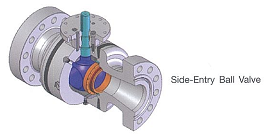
One of ball valve designs that allowed the removal of the valve from the pipeline for disassembly and **maintenance on site** or at the manufacturer's plant.
Defined as a relative level of **risk-reduction** provided by a safety function. **Four levels** (SIL1 to SIL4, with 4 being the most dependable) are defined based on probabilistic analysis (FMEA). **IEC 61508 and IEC 61511** standards define functional safety requirements.
Silicon-oxygen backbone elastomer with excellent **high temperature and low temperature properties**.
A valve gate having flat finely finished **parallel faces**, as opposed to a wedge gate. Such a closure element slides across the seats and **does not depend on stem force** (mechanical seal) to achieve tight shut-off.
A device designed to **prevent the clapper of a check valve from slamming** as it closes upon flow reversal. Hydraulic damping cylinders, rotary vanes and torsion springs are all used for this purpose.
An application involving a slurry fluid. **Coal slurry** consisting of about equal parts of coal and water is transported by pipeline from coal mines to power plants.
A **manual arc welding process** that uses a **consumable electrode coated in flux** to lay the weld. The flux coating disintegrates giving off vapors that serve as a **shielding gas** and providing a layer of **slag**.
A substitute natural gas made from the by-products of chemical plants and refineries.
An end connection in which a pipe or tube is inserted into a **counterbored hole** and then brazed or **fillet-welded**.
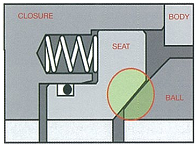
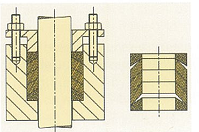
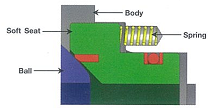
This term has been cited in this valve handbook under 'SEAT'. A picture of a soft seat arrangement has also been included.
Staggered small cracks formed approximately **perpendicular to the principal stress** (residual and/or applied) resulting in a **'ladder-like' crack array** linking pre-existing **HIC cracks**.
Natural gas containing significant amounts of **hydrogen sulfide ($H_2S$)**. **NACE MR0175 / ISO 15156** presents requirements for material qualification in $H_2S$-containing environments.
Exposure to oilfield environments that contain **$H_2S$** and can cause cracking of materials by the mechanism specifically addressed by **NACE MR0175 / ISO 15156**.
The separation of macroscopic particles from a surface in the form of **flakes or chips**, but also resulting from impacts events.
The ratio of the weight of a given volume of fluid to the weight of an equal volume of water (liquid) or to the weight of an equal volume of air (gas).
It is the ratio between gas specific heat in **constant pressure process ($C_p$)** and specific heat in **constant volume process ($C_v$)**, i.e. $amma = C_p / C_v$.
A flat gasket used between two **RF flanges** (without ring grooves). SPWD gaskets contain a **spiral wound metallic filler** for reinforcement.
See **Adapter Spool**.
The simplest type of gear. In a gear set, the input spur gear and output spur gear are aligned on **parallel shafts**.
Compression of an **O-ring's cross-section** between mating surfaces, noted as both a decimal measurement and as a percentage of the original cross-section. **Radial** compression occurs on the OD and ID. **Axial** compression occurs on the top and bottom surfaces.
A form of **hydrogen induced cracking (HIC)** involving **embrittlement of the metal by atomic hydrogen** that is produced by acid corrosion when exposed to water and **hydrogen sulfide**. **NACE MR0103** defines material requirements for resistance to SSC in sour refinery process environments.
A valve used **underwater** generally in a manifold that will **close and isolate a pipeline or process in an emergency**.
Automatic **wellhead valve assembly** which **closes upon loss of power supply**.
A rod or shaft used to **transmit motion from an operator to the closure element** of a valve.
Assembly consisting of the stem extension and the stem extension housing.
A position indicating rod supplied with gate valves. It extends from the top of the valve stem and serves to indicate the relative position of the gate. Also termed **VPI (Valve Position Indicator)**.
A one or two-piece nut which engages the stem threads of a valve and **transmits torque from an operator to the valve stem**.
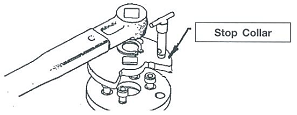
The collar on a ball valve which **restricts the ball to quarter rotation** from the fully open to the fully closed position. See Key Stop.
A procedure used to **isolate a section of line in the absence of a shut-off valve**. After welding a flanged saddle, the line is **'hot tapped'** and an expanding resilient plug is inserted into the pipe bore.
A device used to measure **deformation (strain)** of an object. The most common type consists of a metallic foil pattern whose **electrical resistance changes** as the object is deformed.
Defined as **force per unit area ($F/A$)**, stress is a measure of the intensity of internal forces acting within a body.
Measured as a **percentage increase in the inside diameter (ID) of an O-ring**. Stretch results in a reduction and flattening of the seal's cross-section. There are two types: **installation stretch** and **assembly stretch**.
A bolt **threaded on both ends** used in bolting together two members.
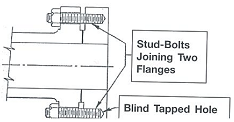
Flanged end or outlet connection in which **thread-anchored studs screwed into tapped holes replace the holes for bolt studs**.
The **annular chamber** provided around a valve stem in a sealing system into which **deformable packing** is introduced.
Metal structure which provides a stable footing when the valve is set on a fixed base.
Average value of exterior roughness often expressed in microinches i.e **RMS (Root Mean Square)** or **Ra (Roughness Arithmetic Average)**.
A transient sudden **rise of pressure in a pipeline**. Caused most frequently by the **sudden closure of a block valve** or **emergency shutdown of a pump**.
A valve designed to **relieve pressure surges in liquid pipelines** thus preventing line rupture due to transient pressures exceeding design limits.
A media temperature that the valve is only required to **survive in typically for a duration of time**. The valve is **not meant to be operated** at this temperature.
A tool for bending or forming cold metal to a required shape.
Cracking that **connects hydrogen-induced cracks (HIC)** on adjacent planes in a steel.
Natural gas that **does not contain hydrogen sulfide ($H_2S$)** or significant quantities of carbon dioxide ($CO_2$).
**Volumetric increase** of an elastomeric material when in contact with a fluid.
A check valve in which the closure element is a **hinged clapper** which swings or rotates about a supporting shaft. See Check Valve.
Form of **SSC** that may occur when a steel contains a local **'soft zone'** of low yield strength material.
T
A pipe or tubing fitting with a side outlet at **right angles**. Resembles a 'T'.
The **maximum amount of tensile stress** (ultimate strength) that a material can withstand before failure or rupture occurs.
A test performed on a specially machined specimen to determine physical properties e.g. **yield strength, ultimate strength and percent elongation**.
Same as **Tensile Test**.
Documents provided by a manufacturer certifying that required tests were performed.
For **relieving pressure in vessels/tubing due to temperature changes**.
The **intentional restriction of flow** by partially closing or opening a valve. A wide range of throttling is accomplished automatically in regulators and control valves.
Characterizes valves in the open position where the bore presents a **smooth uninterrupted interior surface** across seat rings, affording **minimum pressure drop**. There are no cavities that can accumulate debris or impede pipeline cleaning equipment ('pigging').
A valve designed and constructed to allow for **installation/removal of the internal parts (trim) while the valve remains installed in a pipeline**. It is specifically designed for **in-line maintenance**.
The turning effort required to operate a valve. Usually expressed in **pound-feet or N-m** and referred to the stem nut handwheel or operator pinion shaft.
An electrical device on a motor operator which **cuts off power to the operator when allowable torque is exceeded**, thus preventing damage to the valve and/or the operator.
A coiled spring which exerts a force by **twisting about its axis** rather than by compression or elongation.
A length of pipe that is welded to a valve hub or closure. It serves as a transition from the customer's piping to the valve to **compensate for differences in material or size**. (Also known as **Pups**).
A main pipeline transporting oil or gas from wells or storage fields to refineries, loading docks or distribution companies.
The displacement of the closure member from the closed position. For a rotary control valve is the **angle between the closed and the actual position**. The fully open position is identified as **rated travel**.
Those parts (and their materials) of a valve assembly **excluding the valve body, bonnet assembly**, which are **exposed and in contact with the line medium**. Usually consisting of the seat rings, valve ball/obturator and stem.
A particular design of a butterfly valve (triple offset) where the stem is located behind the disc below the centerline of the disc and its cone axis is **offset from the centerline of the disc**. This design is capable of a **very tight shut-off** at temperatures well above 1000F 530C).
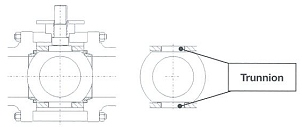
That part of a ball valve which **holds the ball on a fixed vertical axis** and about which the ball turns. The torque requirement of a trunnion-mounted ball valve is **significantly less** than that for a floating ball design.
The random flow of a fluid in which the **velocity at a certain point in the fluid varies irregularly**.
A term used to describe the **ratio between the minimum and maximum flow conditions** seen in a particular system. This term is sometimes incorrectly applied to valves. See **Rangeability**.
The **number of complete revolutions** of a handwheel or the pinion shaft of a gear operator required to stroke a valve from fully open to fully closed or vice versa.
U
A **non-destructive inspection procedure (NDE)** using **high frequency sound waves** to detect **voids and imperfections** throughout the thickness of metal parts. Techniques and procedures are covered in **ASME V, Art. 4, Art. 5, and ASTM A388, A435 and A577**.
Valve designed for **blocking the flow in one direction only**.
A small **3-piece fitting** used to join two lengths of pipe. The connection is **mechanically sealed by an external nut**.
V
A device which **controls or isolates the flow** of a liquid or gas in a conduit or pipeline.
Size determination for a control valve for given process conditions shall be carried out in accordance with **IEC standards**, which specify the prediction method of the achievable **capacity** for any size and style of control valve.
The pressure of a vapor in natural **thermodynamic equilibrium with its condensed phase** in a closed system. Vapor pressure **varies with temperature**.
A small variable profile valve put in a flow line and used with a **pilot** to restrict the flow into the pilot and make the pilot **more or less sensitive to changing conditions**.
A data sheet defining the minimum level of a valve design requirements including the **materials, testing, inspection and certification**.
See **Chevron Packing**.
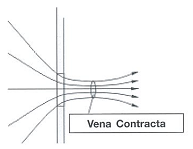
The portion of a flow stream where **fluid velocity is at its maximum** and **fluid static pressure and the cross-sectional area are at their minimum**. In a control valve, the vena contracta normally occurs just **downstream of the actual physical restriction**.
A special pipe plug having a small allen-wrench operated vent valve. Located at the bottom of most ball valves. Used to **vent the body cavity pressure** (when the line valve is closed) to check seat seal tightness or perform minor repairs. Can be removed to blow out debris. See **Block and Bleed** and **Drain Plug**.
A **reduced bore valve** having a bore smaller in diameter than the inlet or outlet. The flow through a venturi valve will be reduced because of the smaller port.
A standard method for measuring the **hardness of metals** (particularly those with extremely hard surfaces). The surface is subjected to pressure by a **pyramid-shaped diamond**. Hardness is determined from the **diagonal of the resulting indention**.
A measure of the **internal friction of a fluid** or the **resistance of a fluid to flow**. Two fluids of identical specific gravity may have quite different viscosities.
Examination of parts and equipment for **visible defects** in material and workmanship.
See **Charpy Impact Test**.
Examination for **internal material defects** by methods such as **radiographic and/or ultrasonic testing**.
See **Stem Indicator**.
W
The thickness of the wall of a **pressure vessel or of a pipe**.
The physical effect often accompanied by loud banging produced by **pressure waves** generated within the piping by **rapid change of velocity** in a liquid system.
The end connection of a valve which is to be installed by **welding into the line**. To prepare the end bevel, it is necessary to know the wall thickness and specified minimum yield strength of the connecting pipe. See **End Bevel**.
Damage to a solid surface generally involving **progressive loss of material** due to **relative motion** between that surface and a contacting substance or substances.
Verification of a component's **resistance under specific wear conditions**.
Of a device that is **protected against intrusion of water, sand, dust or other atmospheric contamination**.
A gate whose seating surfaces are **inclined to the direction of closing thrust** so that mechanical force on the stem produces tight contact with the inclined seat rings. Manufactured to **API 600**.
See **WE** and **End Bevel**.
A flanged piping element with a weld-neck used to provide a **companion flange for installation of flanged valves**. Also used to convert weld end valves to flanged valves or vice versa.
A reducing fitting used on weld end piping components to **adapt from a large sized pipe to a smaller diameter pipe or vice versa**.
The operation of a valve by means of a **handle or lever**. Used on **smaller size and lower pressure class valves**.
Used in connection with a pressure rating. **100 WOG** indicates that the rated pressure is **100 psi** in water, oil or gas service at normal ambient temperatures.
Gears used to transmit motion or power between **right angle shafts** when a **high-ratio reduction is necessary**. The worm is the small gear which drives the larger ring gear. See **BGO (Bevel Gear Operated)**.
The pressure at which a valve is **designed to operate**. Same as operating pressure rating.
Products shaped by means of **forging** or **hot isostatic pressing**.
X
See **RT (Radiographic Test)**.
Y
The **limiting stress** beyond which a material will sustain **permanent deformation**. Up to the yield strength, the material will spring back to its original dimension when the applied stress is removed.
That part of a gate valve which serves as a **spacer** between the **bonnet** and the **operator or actuator**.
A measure of **stiffness** (modulus of elasticity, elastic modulus, or tensile modulus). For small strains, it is defined as the **rate of change of stress with strain** (Δσ/Δε). It is determined from the slope of a stress-strain curve during tensile testing.